Saturday, September 25, 2010

Kirkwood Part 3

Kirkwood began its life as a suburb of Atlanta and was incorporated in 1892. In the early 1920's it was annexed into the city of Atlanta.  An early tour book described it as an “area of beautiful suburban villas.”  Of course, that was written at a time when Kirkwood was considered suburban and not intown.


We moved from Kirkwood when I completed elementary school.  In those days there were no middle schools in Atlanta.  Completion of elementary school was at the end of 7th grade and high school started with the 8th grade. 

There were a combination of reasons we moved then.  My mother had a growing business teaching piano and she wanted a bigger house with a private entrance for her students.  The high school I would have attended was several miles from our house (Kirkwood Elementary was about four blocks from the house and was an easy walk).  And there was an unscrupulous real estate practice then called "blockbusting."  If people were considering moving from Kirkwood, this accelerated the process.  It instilled fears of rapidly declining real estate values and was unfair to both white and black families who lost money to the real estate companies.

Kirkwood did have some difficult years, but since the 1990's it's had a revitalization, as have many older Atlanta neighborhoods.  My old school is now home to many people who've purchased lofts there.  The school was built in 1910 and was added to the National Register of Historic Places in 2002. 

 It's strange to see these interior photos of living spaces there and wonder which classroom this was (3rd grade, 4th grade...?).


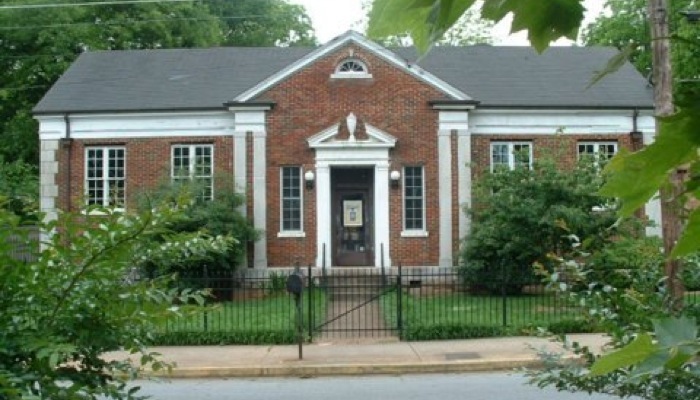
And the public library I used is now a private residence, as well.  It was on the adjacent corner from the school and that made it easy to check out books there after school.  Here's a link to a website set up by the men who've remodeled the library and live there.  Also, on their site they have the video of  the HGTV show that featured their home.


The library building is just across the street from a public park.  The park had a ball field where I played many softball games.

It's very nostalgic writing about this, but I have great memories.


Sunday, September 5, 2010

DragonCon Part 2


Here's my follow-up on DragonCon 2010.  I've uploaded some photos taken today.  I walked around the lobbies of the Hyatt Regency and the Marriott Marquis.  I took some photos there, as well as on Peachtree Street.


As you can see from some of these photos, it was a dangerous place to be.  Menacing figures kept approaching me. 


Everything didn't look dangerous.  Here are some other people I saw.


I took just a few photos, but there are some other blogs with more photos uploaded.  If you're curious, I've put a couple of links here.


Also, I read that Atlanta is now in the record books as having the largest assembled group of costumed Trekkies.  That happened on Saturday and it eclipsed a record set just last month in Las Vegas at the Star Trek convention.

Saturday, September 4, 2010

DragonCon

Every year a large convention (con) is held in Atlanta on Labor Day weekend. The event is DragonCon.  DragonCon was first held in 1987 and has grown to an attendance of 35,000 fans.

It's a combination of sci-fi, fantasy, comic books, anime, costumes and more.  I haven't attended recently but I remember that the shows I attended some years ago were fun.

My interest in the show derived from a love of comic book and pop art.  Also, I've been a sci-fi fan for as long as I can remember.  As a little kid, I was hypnotized by the old Flash Gordon serials that had rockets that backfired.

At one DragonCon I remember going to a Q&A with some of the actors and writers from Star Trek, the Next Generation.  In particular, I remember that Marina Sirtis was there.  At another event (almost 20 years ago) I met a comic book dealer from Charleston, SC and when he heard about some of the books I had, he made a special trip back to Atlanta a few weeks later and visited me.  He had his eye on my issue of Green Lantern # 1.  So, he left with a few of my old Silver Age comic books.

Recently, PBA 30 has produced a documentary based on footage from last year's show.  It's been replayed a few times and I think they plan on distributing it in the next few months to other PBS stations around the country.  Here's a portion of it.

Saturday, August 14, 2010

Ed Ruscha


I've been interested in art since I was about 5 or 6 years old and sat in front of the TV watching Jon Gnagy's drawing lessons. Also, I was drawn to the bright and colorful images of comic books (I learned as much about reading from them as I did from Dick and Jane). Later, in the world of fine art, the style that became Pop Art used images that were appropriated from comic books and commercial art. So, it followed that I would have had a keen interest in that style.

In particular, the work of Ed Ruscha appealed to me. The Standard Gas Station painting shown here included advertising signage and a dramatic perspective. It was the kind of image that was familiar to everyone as subject matter but in this simplified form without any surrounding buildings, it became an interesting image. He's done several versions of this painting, many of which are pictured online.


The gas station was a natural for him to use as subject matter. He's expressed his affinity for the road and traveling on highways. He was born in 1937 and grew up in Oklahoma. When he was about 20 years old, he read Jack Kerouac's On the Road and that influenced him a lot. Even before reading that book, he had hitch-hiked from Oklahoma to Florida when he was 14.

When he was in his early twenties he drove to California and settled in Los Angeles. He became a student at what would become the California Institute of the Arts. The images of Los Angeles and sourthern California became a source of material for him. Other images he's used in his painting are from the American West, where he did a lot of his traveling when he was young.

In addition to painting he was also interested in photograhy. In 1966 he put together a book of photographs called Every Building on the Sunset Strip (and that's what it was). He pre-dated Google Street View by about 40 years.


Many of his paintings incorporate a word (or words) in them. There's a kind of deadpan humor in the combination of words and images, but the meaning is ambiguous. I've included a few of these here.


Here's a short clip from a British TV show that was covering his 50 years of painting retrospective show at Hayward Gallery in London (50 years of painting!).

And here' a segment from a talk he gave at the show.


Thursday, August 12, 2010

Watching Creative People at Work


How many times do many of us watch tv with no particular idea of what we'll end up watching? I'm talking about channel surfing here. But, the other night I went through some channels and found a gem. It was something I really enjoyed and it was luck I came upon it. I found The Pixar Story on CNBC. This was a 2007 documentary that was the story of the people who used the then new CGI technology to create animated movies (including Toy Story and The Incredibles).

The interest I have in a movie like this is that it shows very creative people at work doing something they love. In addition, they're at the forefront of something very new and exciting.

Watching a documentary like this allows the viewer to be present at brainstorming sessions where story boards are taped to the wall and the creative staff is discussing the ideas and how these ideas should work.

Now, fifteen years after Toy Story was created, many may take it for granted. But this movie was made at a time when a small percentage of the population knew about the internet or email. Watching their first movie's transition from idea to reality makes a fascinating documentary. The remainder of the documentary covers their pressure to match expectations with subsequent projects and demonstrates how they succeeded.

I like this kind of documentary and it reminded me of some others I've seen that I'd like to mention.

Two artist documentaries I recall seeing were at the High Museum. One was shown at the exhibit of work by Chuck Close. This was fascinating because if you see paintings by Chuck Close reproduced in magazines or books, they look like photorealism. However, when you see the paintings in person and realize the scale of these paintings, you see the visual tricks the artist uses to make the paintings look so different depending upon whether they're seen at a distance or reduced to magazine size. Watching the painter at work in the documentary was fascinating. The documenatry shows how he works despite his paralysis through a freak collapse of an artery in his spinal chord many years ago. Now he has to attach the brush to his hand and this has caused him to make adaptations in his painting style.

Another documentary I saw at the High was one that showed Jasper Johns at work. This showed him in his studio and showed the deliberation of every stroke that was made by Johns while creating lithograhic plates for a series of prints. If it was possible to show someone thinking on camera, this documentary did so.

If you're interested in moviemaking, I recommend The Making of Fanny and Alexander. This Swedish documentary shows director Ingmar Bergman at work while filming this incredible movie. As the title of my post indicates, I like to watch a day (or days) in the work life of creative people and watching Bergman direct is as rewarding as this kind of documentary can be. When you see him placing his actors (sometimes with his hands) in a position for a shot, you see that he is recreating some scene from his past, his imagination or both. Also, this is apparent when he talks about set design. I had the idea I was watching someone actually film his past and his dreams. It was very interesting viewing.

Another documentary I recall was a series on PBS a number of years ago. It was called Skyscraper. Over several weeks it detailed the design and work that went into building a skyscraper in New York. Meetings were filmed with the architect's staff and with the contractors. It was a chance to be a fly on the wall and observe some very creative (and stressful) work.

The kinds of documentaries I mentioned here would be regular programming if I were in control of a channel.

Friday, July 23, 2010

Silver Age Comic Books Part 2


In Part 1 I talked about the CGC rating system for comic books. Now I have some scans of my books that are CGC rated. The Brave and the Bold No. 28 is the first appearance of Justice League of America. My issue received a grade of 3.5. That puts it in the Very Good range (3.5 to 4.5 is very good). The sealed vinyl around the issue mutes the color in the scan.

A website that brings buyers and sellers together is www.comiclink.com. Currently there are 4 issues of No. 28 on sale there now. There is a 4.5 rated issue (a little better rating than mine) that has a sale pending at $902.00. There's an issue rated 6.5 that has a sale pending at $2500.00. The 5.5 rated book has an asking price of $2275.00. An issue rated 2.0 has an asking price of $425.00 and a bid of $325.00.

I have a Green Lantern No. 26 that has a rating of 4.5. I have a Brave and Bold No. 29 (second JLA appearance) with a rating of 2.5. My JLA No. 15 has a rating of 5.5.


Also, I scanned a few covers that haven't been graded and their condition varies. But it's a sampling of the kinds of books I have. The Batman issue is not in good condition, but it's interesting because it's one of the older books I have. I bought it used when I was a kid and it's almost Golden Age (it's dated 1956). Dell Comics published the Zorro series to coincide with the ABC-TV series in the late fifties. Another cover is a Marvel Comic from 1965. And of course, there was Jimmy Olsen. This cover is from 1960.


Wednesday, July 21, 2010

Silver Age Comic Books Part 1


When I was a kid comic books were a main interest for me. My guilty confession is that I learned most of my reading skills from comic books. I have a specific memory of looking through a Detective Comics and not knowing the words, yet following the story through the pictures. Understanding the words came later. At one time I had a chest that was filled with comic books.

Comic books seemed like a magic world for me as a child. I looked forward to going to the pharmacy where comic books were sold and the anticipation of seeing the new arrivals was incredible. I learned when the new deliveries were made so that I could be sure and not miss anything. In between I would reread the comics I had.

Sadly, the allure of comics dimmed as I got older. Still, I think it’s interesting to look at the covers of some of those old comic books. I’m interested in the artwork and the covers bring back thoughts of the time and place of some old memories.

My fantasy now is to go back in some kind of time machine and tell myself to save all of those comics in plastic covers and don’t let them get away. The comics that I had were from the Silver Age and some of those issues fetch a good sum of money now if they’re in fine or mint condition. If I had known then what I know now…

Many of my comics did disappear. Not knowing the value, I told my mother it was okay to sell some to her music students. I have sold a few at better prices. I had a number one issue of Green Lantern that was in fine condition. I sold it to someone from Charleston, SC who drove to Atlanta to buy it and a few other books I showed him.

I still have a fairly large collection of comic books of varying grades and value. I have trouble getting a handle on what I have and figuring their worth. It’s a work in progress, I suppose.

The reason I’m writing about this now is that DragonCon is coming to Atlanta on Labor Day Weekend and I have some books I’d like to show to collectors. Last year, I went to the trouble and expense of sending off four of my books to have them officially graded. It was a test to understand how this collectors’ grading system works. The CGC number is very official and the comics are sealed in plastic with their CGC number grade and a verbal description of their condition. It’s a system that’s a standard for collectors.

In addtion to these I have a large number of books that have no official grade but I’ll try to put a value on them myself based upon what I’ve learned.

In the next couple of days Im going to scan my CGC graded books and a few others I have. Those scans and the books’ appraisal will be part 2 of this blog post. At the top of this post is a copy of one of the books I've had graded.